
How to Search Criminal Dockets
The county's main online route runs through LGS Online Solutions. Pick the office and the criminal record type first. Fields then appear for searching. A Last Name example appears in the official help text, though not every live field is published there. Date ranges, wildcards, and attorney filters may not exist. Guest access shows index details and previews where offered. Buying a full image takes registration.
Grimes County also posts free County Court at Law docket PDFs, grouped by year and setting type. Treat the criminal, revised criminal, arraignment, ancillary, jury, and trial-announcement lists as snapshots of a setting. They are not complete registers. re:SearchTX adds a second layer, but official reports describe incomplete integration and limits on criminal documents. eFileTexas handles filings. It is not the public docket.
- Identify the court from the charge, citation, notice, or cause number.
- Select the matching office and record type in LGS.
- Check the county PDF archive for the year and setting label.
- Open More Information and preview public Images where offered.
- Confirm the date or request the signed result from the proper clerk.
Three Grimes Criminal Docket Custodians
A Grimes County case lookup often fails for one simple reason. It started with the wrong custodian. The District Clerk keeps felony files once a grand jury indicts. The County Clerk holds the ordinary County Court at Law misdemeanor files. Justice and municipal courts keep traffic, ordinance, and Class C dockets until an appeal opens a county case.
| Level | Record holder | Contact |
|---|---|---|
| Felony after indictment | District Clerk, 12th or 506th District Court | 936-873-4432 |
| County misdemeanor | County Clerk, County Court at Law | 936-873-4472 |
| Class C or ordinance | Named JP or municipal court | Court on citation |
District courts receive cases by rotation, unless a rule or order says otherwise. A transfer or a visiting judge changes nothing about which office holds the underlying record.
What a Criminal Docket Shows
The readable 2022 trial-announcement sample shows what these listings carry. Expect a report title and time, a Docket Call Listing, cause number, and State-versus-party style. Offense and file dates come next. Attorney blocks, charge text, bond data, the current setting, and earlier event dates round it out. Private names and addresses in source files should stay off any republication.
| Cause number | One sample resembles 26811CT1; it is not a universal format. |
|---|---|
| Charge data | Offense, offense date, file date, and entered classification. |
| Bond | Bond and bondsman data, not the result. |
| Settings | Arraignment, pretrial, ancillary, announcement, or jury dates. |
| Disposition | Confirm through the register and signed judgment. |
An index describes activity only. The signed judgment, sentence, dismissal, or deferred order is the firmer proof.
Grimes Criminal Docket Cause Numbers
Consider the example 26811CT1CT1 carefully. Wait, copy it exactly as shown: 26811CT1. That pattern appeared in one County Court at Law calendar, and that is all it proves. It looks like a numeric identifier plus a suffix, but Grimes County publishes no universal guide to the format. Keep every letter and digit. Never force a newer cause into that mold.
When the full number returns no match, confirm the office first. Then search only the public fields supplied. Compare court, charge, file date, and case style before trusting a hit. Similar names alone prove nothing. For older files, ask whether the source is a bound book, microfilm, scanned image, or off-site archive, since online coverage is not guaranteed.
Note: A blank index result does not establish that a Grimes County case never existed.
Stages on a Criminal Docket
A felony starts with charging, then a district filing after indictment. Misdemeanors travel the county court route. Assignment fixes the court and cause number. Bond often appears early, then arraignment, pretrial or ancillary work, an announcement setting, plea or trial, disposition, sentence, and possible appeal. Not every case touches each stage.
Docket flow: Charge Filed › Assignment › Arraignment › Pretrial › Plea or Trial › Disposition › Sentencing.
Appeal notice goes to the trial clerk. A separate cause may open in the First or Fourteenth Court of Appeals. The Grimes County clerk record still supplies what the trial court sent up.
Grimes Trial Announcement Dockets
“TRIAL ANNOUNCEMENT” marks a readiness setting. It is not a verdict. The sample lists a Docket Call Listing, a name-order notation, and an attorney-ready field. Such entries organize pending cases. They establish no conviction, acquittal, dismissal, or sentence.
The archive sorts items into Arraignment, Ancillary, Pre-Trial, Jury Trial, Revised, and Cancelled. Compare a revised PDF with the earlier version. Then call 936-873-4472 to verify a County Court at Law date; for a closed disposition, the county points callers to 936-873-4407. The separate 2017 arraignment file is a scanned, three-page archive item. It proves a dedicated arraignment calendar once existed. It is not a modern or complete criminal register, and its low-text format makes it unsafe to infer unreadable fields.
The official Grimes County calendar page shows the county's calendar route.
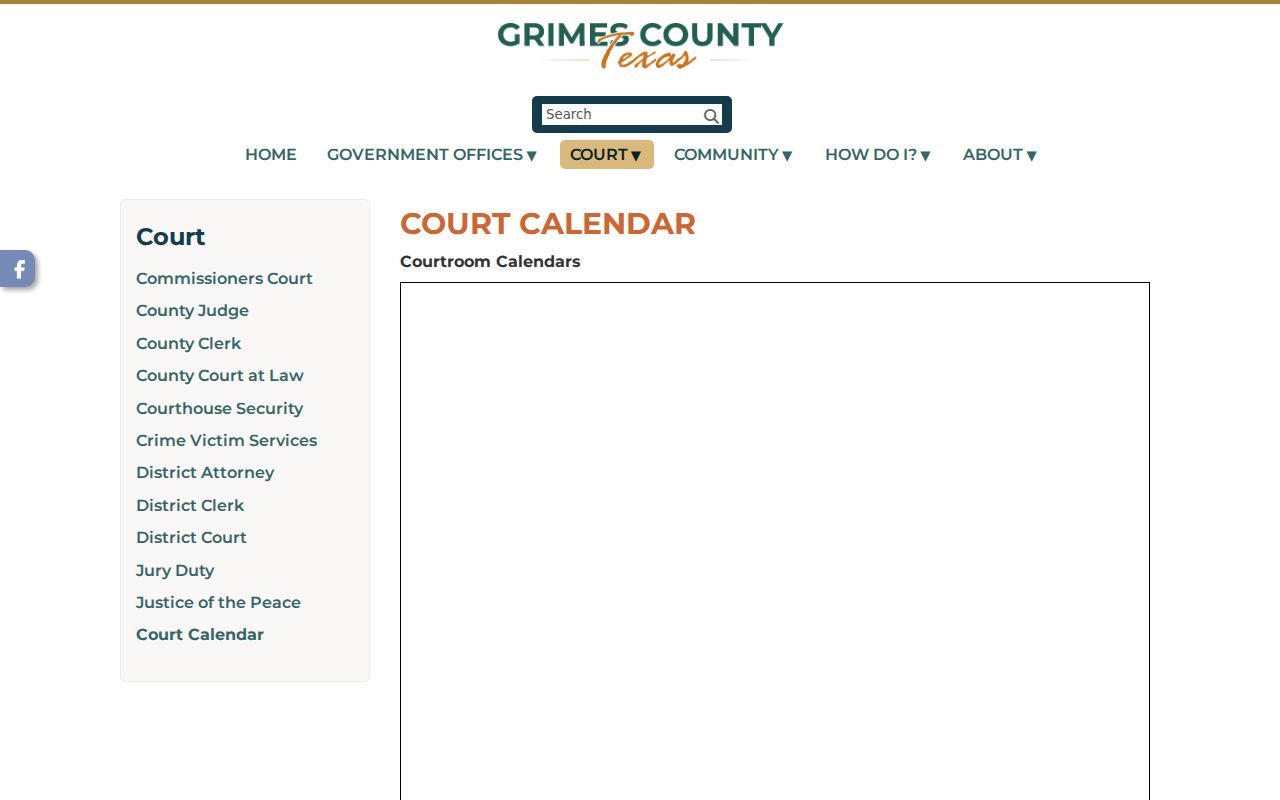
That landing page offers no dependable unified calendar. Use the posted PDFs and phone confirmation rather than treating it as a live schedule.
Setting or outcome? A Grimes County calendar states when and why a case was called. The clerk-confirmed register and signed paper state what the court decided.
Which Court Holds Criminal Dockets
Felony matters after indictment belong to the 12th and 506th Judicial District Courts. The District Clerk keeps those pleadings. County Court at Law ordinarily hears misdemeanors that may carry county-jail confinement. The County Clerk holds those files unless conflict or good cause moves a case elsewhere.
JP courts in Precincts 1 through 3 keep lower criminal records. The municipal courts keep them too. Those cases may never reach the county archive. Appeals from justice and municipal courts land in Constitutional County Court under the local standing order. They may cross-reference the lower cause.
The official District Court page gives local courtroom context.
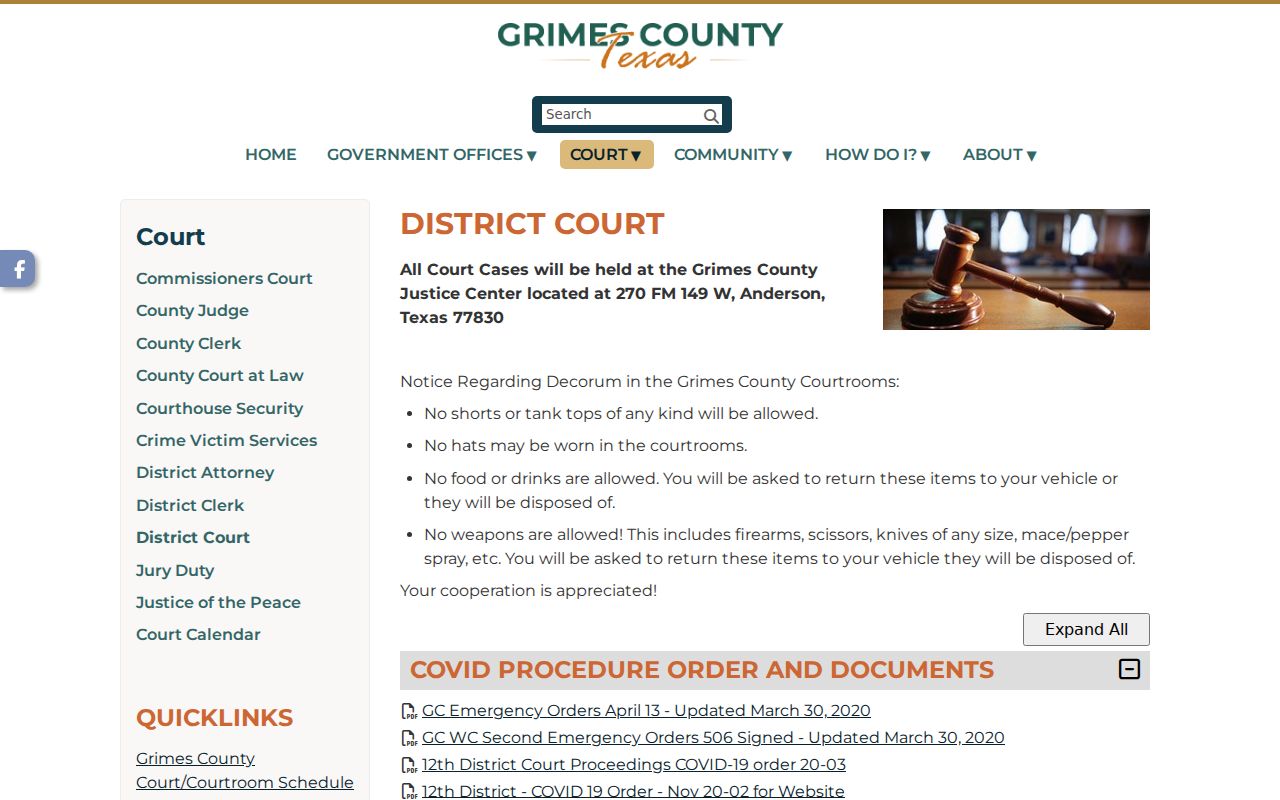
Grimes County district criminal dockets are heard at the Justice Center, and their filings route through the district-court clerk layer.
Grimes Misdemeanor Docket Route
County Court at Law handles most Grimes County misdemeanors. A standing order routes them there, though cases can move. Its page notes jurisdiction that includes county jail time. The file itself lives with the County Clerk, not the District Clerk. That is where a certified copy comes from. The county's docket archive shows how each setting moves through the court.
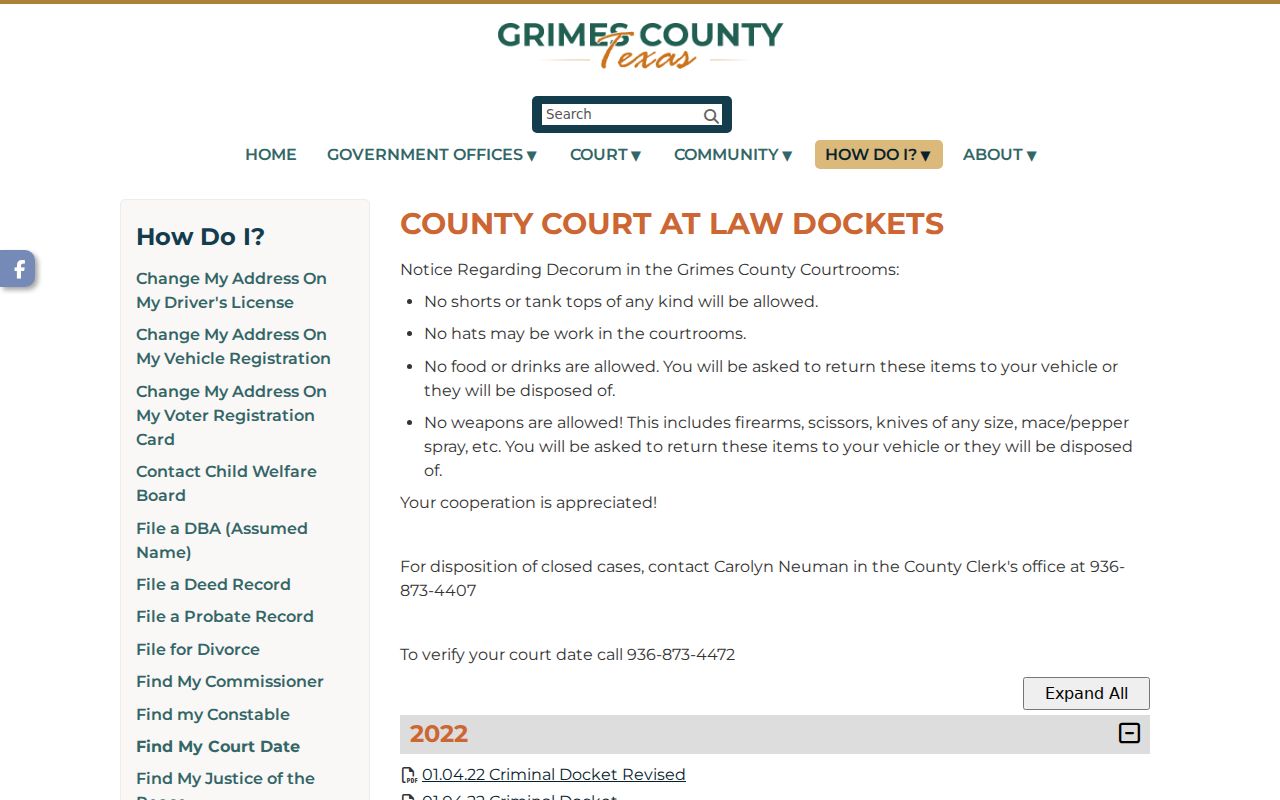
That archive is a decent way to pin down a court date. For the full history and the signed result, though, LGS or the County Clerk still has what you need.
Grimes Criminal Docket Access Channels
LGS gives a free index with previews of Grimes County court records. Registration is required to buy images, and each purchase adds a $0.30 transaction fee. After five criminal or civil purchases, a subscription may kick in. re:SearchTX can round things out with statewide coverage where it is integrated, but a blank or blocked result does not mean the case is missing.
- Visit the District Clerk for felony files or County Clerk for misdemeanors at 270 FM 149 W., Anderson.
- Call 936-873-4432 for felony records or 936-873-4472 for county settings.
- Mail, email, or fax a focused request naming cause, document, and date.
- Use the named JP or city counter for Class C cases.
- Use PIA@grimescountytexas.gov for administrative records, not case files.
The District Clerk lists fax 936-873-2514 plus an email; the County Clerk lists email only. Neither office promises a set turnaround. Before ordering, confirm payment terms and the return-envelope rules.
Public Access and Sealed Criminal Dockets
Start any request with the clerk. Case records belong there, but non-case judicial records follow Texas Rule of Judicial Administration 12. Administrative county records go through the Public Information Act instead.
Juvenile and sealed material may be left out, shortened, or restricted. A case can appear in a public index. That does not make every image free to copy.
Never work around a redaction. Give the clerk the cause, the document title, and the date. Then ask the right question. Is the item a public case record, a Rule 12 record, sealed material, or held somewhere else?
Key rules:
Texas Rule of Judicial Administration 12 opens judicial records subject to listed exceptions.
Texas Family Code Chapter 58 governs juvenile confidentiality and sealing.
Texas Government Code Chapter 552 covers administrative information but is not the usual case-record route.